

If you stand in the bustling city proper of Kabankalan and look just across the mighty Ilog-Hilabangan River, you will see a sweeping expanse of green. Just a single kilometer away from the dense commercial grids of the Poblacion lies Barangay Camugao—a community that sits tantalizingly close to the urban center, yet fiercely maintains its serene, agricultural identity.
For travelers, locals tracing their roots, and anyone fascinated by the rapid urbanization of southern Negros Occidental, Camugao presents a beautiful paradox. It is an agro-industrial powerhouse that simultaneously serves as the fresh vegetable basket of the city.
Let’s dive into the history, the harvest, and the heritage of this vital Kabankalanon barangay.
The Legend of the Pomelo and the River Crossing
To understand the soul of Barangay Camugao, you have to look at its geography and its name.
During the early days of Kabankalan’s settlement, this specific area was teeming with “Cabugao” (Pomelo) trees. These native citrus trees grew wild and abundant in the fertile soils along the riverbanks, prompting the early locals to name the settlement after the fruit. Over time and through generations of dialect shifts, Cabugao seamlessly evolved into Camugao.
Source: The Food Travel Agency
Historically, the progress of Camugao was intrinsically tied to the Ilog-Hilabangan River. Because the barangay is physically separated from the city proper by this massive waterway, early residents had to rely on bancas (wooden outrigger canoes) to ferry their goods and families across.
Local elders fondly recall a time when the river water was pristine. During low tide, residents would dig tabay (makeshift wells) right into the river’s sand islets to draw crystal-clear, potable drinking water. While modern bridges have long since replaced the dangerous canoe crossings—finally linking Camugao’s economy directly to the Poblacion—the river remains a defining geographical feature of the community.
The Coconut and Vegetable Basket of Kabankalan
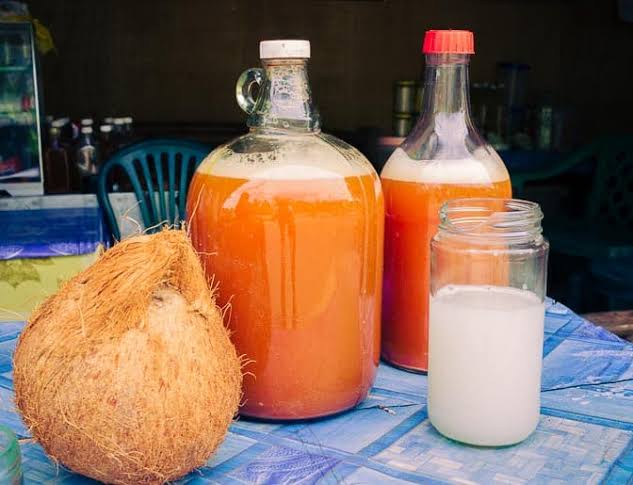
While the original pomelo trees are now a rare sight, nature did not leave Barangay Camugao empty-handed. The area was quickly besieged by towering coconut palms, transforming the barangay into a massive local producer of coconut by-products.
Today, Camugao is locally famous for its traditional coconut harvest. It is a rich, localized source of:
- Tuba (Coconut Wine): Freshly tapped from the palms, this traditional fermented wine is a staple at local gatherings.
- Coconut Vinegar (Suka): Fermented naturally and highly sought after in local markets.
- Fresh Buko Juice: A refreshing daily staple for the residents.
Beyond coconuts, Camugao’s 398 hectares of incredibly fertile soil make it one of the most reliable food baskets in Kabankalan City. Rather than relying solely on massive single-crop plantations, the residents sustain themselves and the city through dense backyard farming. A walk through the rural pockets of the barangay reveals thriving plots of eggplant, okra, string beans, corn, and kangkong (water spinach), which are harvested and sold in the city markets every single morning.
The Home of an Agro-Industrial Giant
Despite its rural, agricultural charm, Barangay Camugao holds a massive trump card in the economic landscape of Negros Occidental.
Situated specifically within Sitio San Juan is the sprawling complex of the Universal Robina Corporation (URC) – SONEDCO (Southern Negros Development Corporation). Originally beginning its operations in September 1987, this massive sugar mill is one of the most critical industrial anchors in the province.
The presence of SONEDCO creates a unique dynamic in Camugao. During the milling season, the barangay becomes a highly active logistical corridor. Massive trucks loaded with freshly harvested sugarcane from all over southern Negros roll through the area, providing thousands of direct and indirect jobs to the residents of Camugao and its neighboring barangays.
A Progressive Community
Today, with a population approaching 3,000 residents, Barangay Camugao is recognized for its progressive local governance. In 2023, it was proudly recognized as a Zero Open Defecation (ZOD) Barangay, a testament to the community’s commitment to public health, sanitation, and environmental dignity.
With its dedicated Day Care centers, active community cooperatives like the SONEDCO San Juan Multipurpose Cooperative, and localized health centers, Camugao proves that a community can balance industrial might with localized, sustainable living.
Barangay Camugao is more than just the land across the river. It is a deeply rooted community that feeds the city, drives the sugar economy, and stands as a proud, green neighbor to the Rising City of the South.