

When you think of Kabankalan City today, images of bustling commercial centers, massive sugar mills, and a rapidly urbanizing landscape immediately come to mind. But before Kabankalan became the “Rising City of the South,” the foundation of its commerce and industry was laid in a coastal settlement that predates the modern city proper.
Welcome to Barangay Daan Banua.
In the local Hiligaynon dialect, Daan Banua translates literally to “Old Town.” This name is not just a geographical label; it is a profound historical badge of honor. As the only barangay in Kabankalan whose northernmost tip touches the Panay Gulf, Daan Banua is a fascinating intersection of deep-rooted history, maritime trade, and a modern dual economy driven by farming and fishing.
If you want to understand the origins of Kabankalan’s wealth, you have to look at the waters and the ruins of Daan Banua.
The Ancient Trading Center of Southern Negros
To truly appreciate the legacy of Daan Banua, we must rewind to the Spanish colonial regime. During this era, the neighboring municipality of Ilog served as the Capital of Negros Island, and Kabankalan was merely a subordinate barrio under its jurisdiction.
However, Daan Banua was the beating economic heart of the area. It functioned as the premier trading center for Southern Negros. The geography of the barangay was its greatest asset: it was bordered by the Binicuil River, which, at the time, was deep, wide, and highly navigable for large sea vessels.
Through this vital waterway, the raw sugar produced by early muscovado (unrefined brown sugar) mills was exported to different parts of the Philippines. These goods were loaded onto large, traditional wooden sailboats known to the locals as Batil and Paraw. For decades, the port of Daan Banua was a chaotic, prosperous hub of merchants, sailors, and farmers driving the island’s early sugar trade.
The Panay Migrants and the Letter “G”
The rich opportunities in Daan Banua attracted bold pioneers. The very first significant wave of settlers to tame and cultivate the lands here did not come from within Negros, but from across the gulf—specifically from the island of Panay, originating largely from the town of Guimbal in the Province of Iloilo.
These early settlers brought with them their farming expertise, their maritime skills, and their families. This migration created a fascinating demographic quirk that still exists in the barangay today: because the original settlers hailed from Guimbal, a massive percentage of the traditional family names in Daan Banua begin with the letter “G.” Many of these original families went on to own wide tracts of land, shaping the agricultural layout of the barangay for generations.
The Shift to Modernity and the Ruins of Hacienda Carmen
Nothing lasts forever, and the golden era of Daan Banua’s maritime dominance eventually faced the unstoppable march of modern infrastructure.
At the turn of the century, the once-flourishing river commerce slowly began to die a natural death. The construction of provincial roads and massive concrete bridges interconnected the northern and southern parts of Negros Occidental by land, making the slow Batil sailboats obsolete.
Simultaneously, the crude, animal-powered muscovado mills of Daan Banua were entirely replaced by massive, modern sugar centrals built in other parts of the province. Kabankalan’s central districts outpaced Ilog in progress, eventually elevating it to a city, while Daan Banua transitioned into a quiet, rural barangay.
Source: Wikimedia Commons
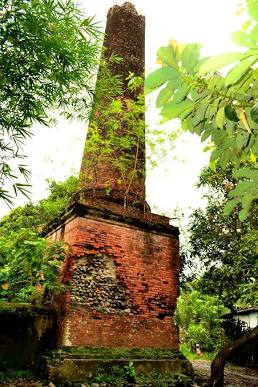
However, the past hasn’t been completely erased. If you venture into a specific area known today as Hacienda Carmen, you can still find the haunting, dilapidated ruins of the old muscovado sugar mills. These crumbling brick smokestacks stand tall amidst the greenery—a silent, living memory of the days when Daan Banua fueled the economy of the island.
A Coastal Economy: Farming and the Bounty of the Sea
Today, Barangay Daan Banua is a thriving, peaceful community that has masterfully adapted to the modern era. Because it sits right on the coast of the Panay Gulf and is separated from neighboring Himamaylan City by the Binicuil River, the local economy is deeply dual-natured.
- Farming: The expansive plains inland from the coast are highly fertile, allowing local farmers to cultivate sugarcane and rice, keeping the barangay’s agricultural roots alive.
- Fishing and Aquaculture: Because of its unique coastal tip, Daan Banua is a prime location for aquaculture. The area is dotted with fish ponds cultivating milkfish (bangus) and crabs. Local fisherfolk still launch their boats into the gulf, bringing in fresh catches daily.
This abundance of fresh seafood has led to a localized culinary scene. The barangay is home to hidden-gem local eateries and floating restaurants that serve freshly harvested oysters (talaba), scallops, and crabs, offering visitors a deeply authentic, sea-to-table dining experience directly over the fish ponds.
A Progressive Community Looking Forward
Despite its “Old Town” moniker, Daan Banua is pushing toward a highly progressive future. The barangay council places a massive emphasis on community health and sanitation. In 2023, Daan Banua achieved a massive milestone when it was officially declared by the Kabankalan City Health Office as a Zero Open Defecation (ZOD) Barangay, a testament to the community’s commitment to public health and environmental dignity.
Barangay Daan Banua is the anchor that holds Kabankalan City to its past. It is a community that remembers the sails of the Batil ships, honors the ruins of its ancient sugar mills, and continues to thrive on the timeless bounty of the land and the sea.