

When you traverse the expansive landscape of Kabankalan City, you encounter a fascinating mix of ancient tribal history and modern industrial might. But if there is one place that perfectly bridges the gap between the untamed wilderness of the past and the booming agro-industrial economy of the present, it is Barangay Tabugon.
Spanning a massive 3,882 hectares with a population exceeding 11,600 residents, Tabugon is one of the most significant and storied barangays in southern Negros Occidental. For historians, agricultural enthusiasts, and heritage travelers, the story of Tabugon is a thrilling ride through indigenous legends, presidential interventions, and the rise of the sugar empire.
“Tabog”: Shooing Away the Wild
To truly appreciate the modern, bustling streets of Tabugon today, you have to imagine what the land looked like centuries ago.
Originally, the area was populated by the indigenous Bukidnon people (referred to by locals as the Buki). They were led by a famous and powerful chieftain named Ompong, a respected Babaylan (traditional healer) who, according to local lore, lived in a massive house with his many wives.
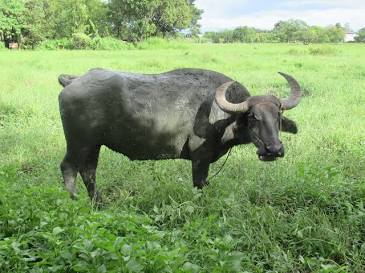
During these early days, the land was an absolute wilderness. The rivers and watering holes were teeming with wild animals—monkeys, wild pigs, deer, and fierce Simarons (wild carabaos). When the early lowland farmers began migrating to the area, they found that simply walking to their fields was a daily struggle. Herds of these wild animals would constantly block the paths as they flocked to the water holes to drink and bathe.
The farmers had to spend a significant amount of time aggressively shooing and driving the animals away just to get to work. In the local Hiligaynon dialect, the act of driving or scaring away is called “Tabog.” Because this exhausting task was a daily reality for every settler, the word stuck. Eventually, the entire settlement became known as Tabugon—the place where the wild is driven away.
Source: Wikipedia
The Magsaysay Era and the “Luzville” Dream
Historically, Tabugon started as a humble sitio of the neighboring Barrio Tagoc before finally gaining its independence and becoming a full-fledged barrio in 1951. However, its true turning point occurred a few years later on the national stage.
Because of its vast, untapped agricultural potential, Tabugon caught the attention of the Philippine government. On September 23, 1955, under the administration of the beloved President Ramon Magsaysay, the area was officially proclaimed a massive resettlement zone (PLS-38). This project was spearheaded by the National Resettlement Rehabilitation Administration (NARRA) to provide land to farmers migrating from across the Western Visayas.
President Magsaysay himself visited the area aboard a helicopter. The exact spot where his helicopter landed is still preserved today, marked by the iconic Barangay Rotunda.
In fact, the national government had grand plans for the area. They envisioned Tabugon as the central community hub for all surrounding barangays (including Tagoc, Pinaguinpinan, Inapoy, and Bantayan). The plan was so ambitious that they initially intended to rename the entire town “Luzville,” in honor of the President’s wife, First Lady Luz Banson Magsaysay. While the name change never officially took root, the resettlement program turned Tabugon into a flourishing agricultural powerhouse.
The Dacongcogon Sugar Mill Boom
If the 1950s brought the people, the late 1960s brought the wealth.
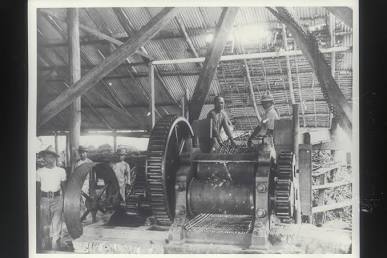
In 1968, the landscape of Tabugon changed forever with the establishment of the Dacongcogon Sugar and Rice Milling Co. Inc. Organized near the Tablas River under the visionary leadership of Monsignor Antonio Y. Fortich and the late Mr. Benjamin Gaston, the mill was a monumental achievement for the community.
Source: Search UW-Madison Libraries – University of Wisconsin–Madison
The presence of the Dacongcogon Mill caused the population to explode geometrically. It created a massive economic ripple effect, drawing mechanical engineers, truck drivers, and thousands of seasonal agricultural workers to the area. Tabugon was no longer just a farming village; it was an industrial cornerstone of the “Sugar Bowl of the Philippines.”
A Thriving Modern Community
Today, Barangay Tabugon is a highly progressive and bustling community. It features impressive local infrastructure, including its own public market, the Kabankalan City Hospital extension, and numerous educational institutions like the Tabugon National High School.
Despite its rapid industrialization, the people of Tabugon retain a deep connection to their roots. They are hardworking, fiercely proud of their history, and deeply committed to community progress.
Barangay Tabugon stands as a shining example of transformation. It is a place that started with farmers driving away wild animals with sticks, caught the eye of a President, and eventually built the roaring engines of a sugar empire.